


If you’ve ever woken up with a finger stuck in a bent position, or noticed a painful snap every time you try to straighten it, you may be dealing with trigger finger. Tasks most people don’t think about twice, like gripping a coffee mug, typing on a keyboard, or buttoning a shirt, can become genuinely painful or frustrating. In this post, I want to walk you through what trigger finger is, what tends to cause it, how to recognize the symptoms, and what your treatment options may look like, from simple conservative measures all the way to surgical correction when it’s needed.
Key Takeaways
- Trigger finger occurs when inflammation narrows the tendon sheath, making it harder for the tendon to glide smoothly through the finger.
- It can affect any finger and may be more common in people with diabetes, rheumatoid arthritis, or those who perform repetitive gripping activities.
- Many cases respond well to conservative treatment, including rest, splinting, and injections.
- When non-surgical options don’t provide enough relief, a procedure may be considered to release the tightened tendon sheath.
What Is Trigger Finger?
Trigger finger, medically called stenosing tenosynovitis, is a condition involving the tendons that move your fingers. Each finger is controlled by tendons that run from muscles in the forearm down through a series of snug tunnels called tendon sheaths. These sheaths keep the tendons positioned correctly and allow them to glide smoothly as you flex and extend your fingers.
When inflammation develops in or around a tendon sheath, that smooth motion can become restricted. The sheath narrows, and the tendon struggles to pass through freely. In some cases, a small nodule or thickening forms on the tendon itself. When you try to bend or straighten the finger, you may feel a catching sensation, or, in more advanced cases, the finger may lock completely in a bent position. That catching or locking motion is what gives this condition its name.
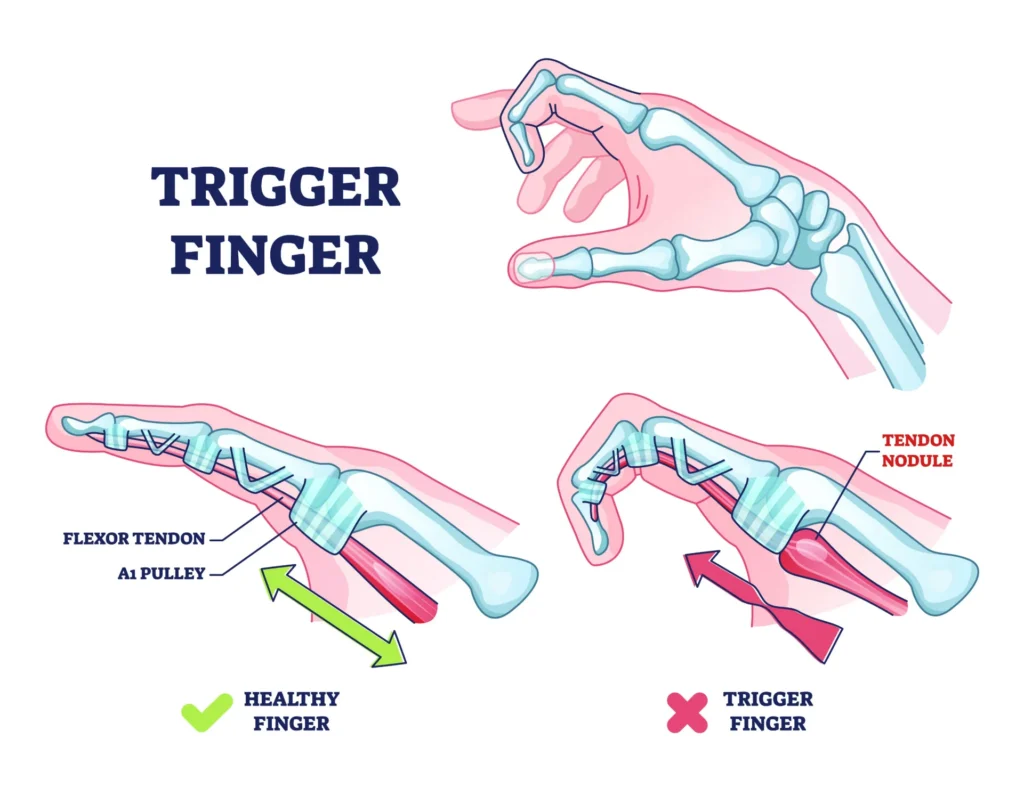
Trigger finger can affect any finger on either hand. It tends to show up most often in the ring finger or thumb. When the thumb is involved, some providers refer to it as trigger thumb. It’s also worth knowing that trigger finger can develop in both hands at the same time, and more than one finger can be affected simultaneously.
What Causes Trigger Finger?
The exact cause isn’t always clear-cut. However, several factors tend to increase a person’s likelihood of developing trigger finger:
- Diabetes and rheumatoid arthritis, both of which are associated with higher rates of tendon inflammation
- Repetitive gripping activities at work or during hobbies, such as farming, playing an instrument, or using hand tools
- Age between 40 and 60, though it can occur in younger people as well
- Female sex, as trigger finger tends to develop more frequently in women than men
That said, trigger finger sometimes develops without any obvious explanation at all. Inflammation in the tendon sheath can occur even when none of the above risk factors are present.
Recognizing the Symptoms
Common signs of trigger finger may include:
- Stiffness in the finger, especially first thing in the morning
- A clicking, snapping, or popping sensation when bending or straightening the affected finger
- A tender lump or nodule at the base of the finger, near the palm
- The finger locking in a bent position. Sometimes you can straighten it on your own; sometimes you can’t
- Pain when gripping objects or pressing on the base of the finger
In more advanced cases, the finger may become locked in a curled position. Patients often have to use their other hand to physically straighten the finger, which can be uncomfortable and, understandably, alarming.
How Do We Diagnose Trigger Finger?
One of the things I appreciate about trigger finger is that it generally doesn’t require complex or expensive testing to diagnose. In many cases, I can identify the condition through a careful physical examination.
During your visit, I’ll ask about your symptoms, including how long you’ve had them, which finger is affected, whether they seem to be getting better or worse, and how they’re impacting your daily activities. I’ll feel along the palm side of the affected finger and check for tenderness, swelling, or a nodule near the base. I’ll also observe how your finger moves as you flex and extend it.
Imaging studies like X-rays are not typically needed to confirm trigger finger. That said, I may order imaging in certain situations; for example, to rule out other conditions that can cause similar symptoms, like arthritis of the hand or a fracture. Every patient is different, and I always tailor my evaluation to what the individual picture calls for.
Treatment Options for Trigger Finger
Non-Surgical Treatment
For many patients, particularly those with mild to moderate symptoms, non-surgical treatment can bring meaningful relief.
Rest and activity modification. Temporarily reducing or avoiding activities that aggravate the tendon can sometimes allow inflammation to settle on its own. This can be especially helpful for patients whose trigger finger appears linked to repetitive hand use.
Splinting. A splint that holds the affected finger in a straightened position, typically worn at night, can give the tendon a chance to rest and reduce morning stiffness. Some patients may benefit from wearing the splint during certain activities as well, depending on the severity of their symptoms and what their daily routine involves.
Corticosteroid injections. A steroid injection into the tendon sheath may be very effective at reducing inflammation and improving finger movement. Many patients experience meaningful relief after a single injection, though some may benefit from more than one over time. This is a quick, in-office procedure that is generally well tolerated.
For patients interested in exploring additional options, I also offer regenerative treatments including platelet-rich plasma (PRP) therapy, which may support healing in certain conditions. Whether that’s appropriate for your situation is something we can discuss together during your consultation.
Surgical Treatment
When conservative measures don’t provide adequate relief, or when the finger is locked and no longer responding to other interventions, surgery may be considered. The procedure used to treat trigger finger is called a trigger finger release, and it’s a relatively minor outpatient surgery. During the procedure, I make a small incision at the base of the affected finger. Through that opening, I carefully divide the A1 pulley, the part of the tendon sheath that is causing the restriction.
Trigger finger release is typically performed under local anesthesia, meaning you remain awake but the area is completely numb. Most patients go home the same day. The procedure is generally brief and carries a low risk of complications, particularly when performed by an experienced hand and wrist surgeon.
Summary
Trigger finger develops when inflammation in the tendon sheath restricts the smooth movement of a finger’s tendon. It can produce stiffness, clicking, pain, and locking of the finger in a bent position. Several factors may increase the risk, including diabetes, rheumatoid arthritis, repetitive hand activities, and age. Diagnosis is typically made through a physical exam, without the need for complex imaging. Treatment follows a conservative-first approach: rest, splinting, and corticosteroid injections are often the first steps. When those aren’t sufficient, trigger finger release surgery is an outpatient procedure that may help restore comfortable, full finger movement. If you’re experiencing trigger finger symptoms, consider scheduling a consultation.
Frequently Asked Questions
Can trigger finger go away on its own?
In very mild cases, symptoms may improve with rest and reduced activity. However, many cases of trigger finger do not resolve without some form of treatment. If you’re experiencing persistent locking, significant pain, or worsening stiffness, getting evaluated sooner rather than later may support your outcomes.
How long does recovery from trigger finger surgery typically take?
Recovery timelines can vary from person to person. Most patients are able to resume light daily activities within a couple of weeks following surgery. A return to more physically demanding tasks may take several additional weeks. Your surgeon will give you a clearer, more personalized timeline based on your specific situation and how your healing progresses.
Is trigger finger surgery painful?
The procedure is performed under local anesthesia, so you shouldn’t feel pain during the surgery itself. Some soreness and mild discomfort in the days following the procedure are to be expected, but most patients find this manageable with guidance from their care team. Before your procedure, we’ll take time to explain what to expect so you feel prepared going in.
Can trigger finger affect more than one finger at a time?
Yes, it can. Trigger finger may develop in multiple fingers, and it can affect both hands. Patients with underlying conditions like diabetes or rheumatoid arthritis may face a somewhat higher risk of developing trigger finger in more than one finger simultaneously. If that’s the case, we’ll discuss the best approach for addressing each affected finger.