


Medically reviewed by Christopher L. Dillingham, M.D. | Reviewed June 2026
It’s not uncommon for a patient to walk into my Sarasota office asking about golfer’s elbow vs. tennis elbow, and the names trip people up more than they help. Despite what the labels suggest, you don’t need to swing a club or a racket to end up with either one. I see golfer’s elbow in weightlifters and warehouse workers, and tennis elbow in painters, plumbers, and people who spend all day on a keyboard and mouse. Both come down to overuse, just on opposite sides of the elbow, and figuring out which one you’re dealing with is the first step toward treating it properly. Here’s how I tell golfer’s elbow and tennis elbow apart, what actually causes each, and how I approach treatment for both.
Key Takeaways
- Tennis elbow affects the tendons on the outside of the elbow, while golfer’s elbow affects the tendons on the inside.
- Both conditions are overuse injuries, and despite their names, neither requires playing the associated sport to develop.
- Conservative treatment, including rest, therapy, bracing, and sometimes regenerative options, resolves the majority of cases.
- Surgery is reserved for patients whose symptoms do not improve with non-surgical care.
What Is Tennis Elbow?
Tennis elbow, known clinically as lateral epicondylitis, develops when the tendons on the outside of the elbow become irritated or damaged. These tendons attach to a bony bump called the lateral epicondyle and are responsible for extending the wrist and fingers. Repetitive gripping, twisting, or lifting motions place ongoing strain on this area, and over time the tendon can develop small areas of breakdown rather than true inflammation in the way people typically picture it.
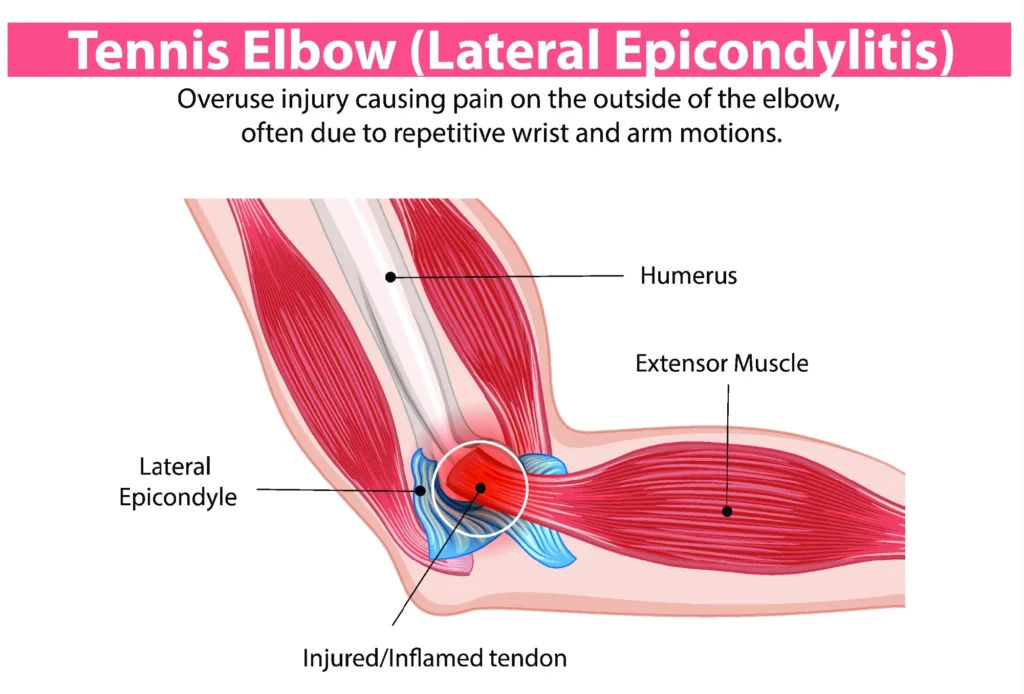
The name comes from its association with the tennis backhand, where repeated wrist extension under load stresses these tendons. In practice, I see this condition just as often in people who have never picked up a racket. Painters, plumbers, anyone who uses a screwdriver repeatedly, and even office workers who type and use a mouse for long stretches can develop the same pattern.
What Is Golfer’s Elbow?
Golfer’s elbow, known clinically as medial epicondylitis, is the mirror image. It affects the tendons on the inside of the elbow, attaching at the medial epicondyle, and is triggered by repetitive wrist flexion and forearm rotation. The golf swing, particularly the lead arm during the downswing, places exactly this kind of stress on the inner elbow tendons.
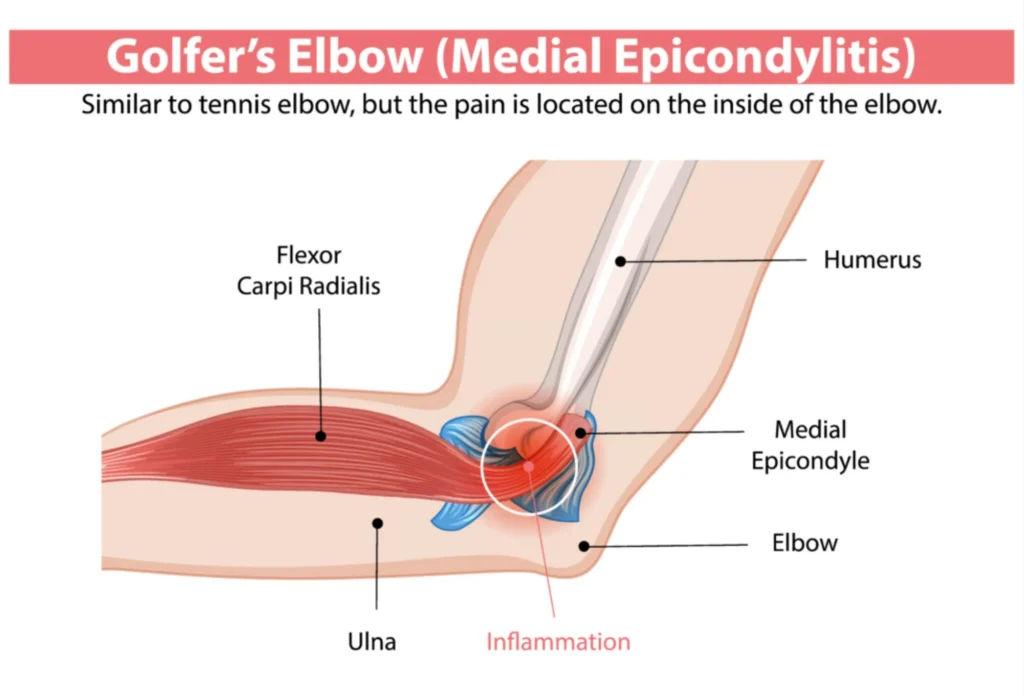
As with tennis elbow, the activity in the name is not a requirement for the diagnosis. I see golfer’s elbow in weightlifters, in people who do a lot of manual labor involving gripping and pulling, and occasionally in patients who cannot point to any specific activity at all.
Symptoms to Watch For
With tennis elbow, patients typically notice pain that radiates down the outside of the forearm, often worsening with activities like shaking hands, lifting a coffee pot, or turning a wrench. Grip strength frequently declines, sometimes to the point where simple tasks like opening a jar become difficult.
Golfer’s elbow tends to produce pain along the inner forearm, aggravated by gripping combined with wrist flexion, such as swinging a golf club, lifting a suitcase, or even certain pushup variations. Some patients also notice mild tingling into the ring and small fingers if the nearby ulnar nerve becomes irritated alongside the tendon.
In both conditions, symptoms usually build gradually rather than appearing overnight, and patients often adjust their grip or activity level without realizing it until the compensation itself starts causing problems elsewhere in the arm.
How to Tell Them Apart
The most reliable distinguishing feature is location. Tennis elbow causes tenderness and pain on the outside of the elbow, often radiating into the forearm with wrist extension or gripping. Golfer’s elbow causes tenderness on the inside of the elbow, typically worsened by wrist flexion or forearm rotation, like turning a doorknob or shaking hands firmly.
Both conditions tend to flare with similar everyday activities, which is part of why patients have trouble telling them apart on their own. Lifting a coffee mug, carrying a grocery bag, or even a firm handshake can provoke symptoms in either condition. During an exam, I apply targeted resistance to specific wrist and forearm movements to pinpoint which tendons are involved.
What Causes These Conditions?
Both tennis elbow and golfer’s elbow are classic overuse injuries. They develop gradually from repetitive strain rather than a single traumatic event, which means symptoms often build over weeks or months before a patient notices them enough to seek treatment. A sudden increase in activity, a new sport, a home renovation project, or simply more time on the golf course than usual can accelerate the process.
Grip strength and forearm conditioning play a role as well. Patients with weaker forearm muscles relative to the demands they are placing on them seem to develop symptoms more readily, which is part of why strengthening is such a central piece of treatment rather than just rest.
Age is a factor too, though not in the way most people expect. These conditions are most common in the forty to sixty age range, likely because tendon quality naturally changes over time and recovery from repetitive strain slows down. That said, I treat plenty of younger patients, particularly competitive athletes and people in physically demanding jobs.
What I See in My Patients
Sarasota keeps me busy with both conditions year-round, and not just from the golfers and club players you’d expect. I see golfer’s elbow in landscapers and weekend warriors doing yard work in the heat just as I see it in someone coming off the course. Tennis elbow shows up the same way, plenty of racket sport patients, but also professionals who spend hours a day gripping a phone and a keyboard. What I notice most is that people tend to misdiagnose themselves based on the name alone. I have also had golfers convinced they have golfer’s elbow because that is the sport they play, when the exam clearly points to the opposite side of the elbow.
My Approach to Treatment
For both conditions, I start with the same conservative framework: relative rest from the aggravating activity, physical therapy focused on eccentric strengthening of the forearm tendons, and bracing when appropriate to offload the irritated area during daily activities. This combination resolves the majority of cases I see, though it does take real time and consistency from the patient.
When symptoms persist despite a genuine course of conservative care, I may discuss regenerative treatments such as PRP therapy. PRP uses a concentrated sample of the patient’s own blood, injected directly into the irritated tendon, and I have found it to be a reasonable option for chronic cases that have not responded to rest and therapy alone.
I have also found that patients who modify their grip or technique, sometimes with input from a coach or pro, recover more durably than those who simply rest and then return to the exact same mechanics that caused the problem in the first place. Rest alone tends to be a short-term fix if the underlying movement pattern does not change.
Surgery is the last step, not the first, and I generally only recommend it once non-surgical options have been exhausted. When it is necessary, the goal is to remove the damaged tendon tissue and restore a healthy attachment point, allowing the tendon to heal in a stronger position than where it started.
When Should You See a Specialist?
Mild cases of either condition may improve with rest and over-the-counter anti-inflammatory measures. I generally recommend an evaluation if pain persists beyond a few weeks despite activity modification, if it is affecting your grip strength, or if you are unsure which condition you are dealing with.
Summary
Tennis elbow and golfer’s elbow share more in common than their names suggest: both are overuse tendon injuries, both respond well to a structured conservative approach, and both can become more stubborn the longer they are ignored. The real distinction lies in which side of the elbow is involved and which specific movements aggravate it. If elbow pain has been limiting your golf game, your tennis match, or simply your grip on a coffee cup, schedule an evaluation so we can confirm which tendons are involved and get you started on the right treatment plan.
Frequently Asked Questions
Do I need to play golf or tennis to develop these conditions?
No. Both conditions are caused by repetitive strain on specific tendons, and I see them regularly in patients whose only repetitive activity is typing, manual labor, or other everyday tasks.
Can tennis elbow and golfer’s elbow occur at the same time?
It is uncommon but possible, particularly in patients with very high activity demands on both sides of the elbow. A thorough exam can clarify whether one or both tendons are involved.
Will a brace alone fix tennis elbow or golfer’s elbow?
A brace can help offload the irritated tendon during daily activities, but it generally works best alongside, not instead of, a structured therapy program focused on strengthening.
Is surgery often needed for these conditions?
No. The majority of patients I treat for tennis elbow or golfer’s elbow improve with conservative care, and surgery is reserved for the smaller group whose symptoms persist despite a genuine non-surgical effort.
Can these conditions come back after treatment?
They can, particularly if the activity or technique that caused the original strain goes unchanged. I spend time discussing grip, equipment, and mechanics with patients precisely because addressing the root cause tends to matter as much as treating the current flare-up.