
Medically reviewed by Christopher L. Dillingham, M.D. | Reviewed May 2026
A common question I hear from new patients goes something like: “My doctor mentioned arthroscopy. What is shoulder arthroscopy and what can it treat?”
Shoulder arthroscopy has changed the way I approach care in my Sarasota practice. It lets me see inside a joint, and often fix the problem at the same time, through incisions so small that most patients are surprised when they see them afterward.
Whether you’ve been told you may need shoulder arthroscopy, or you’re just starting to look into what’s causing your shoulder pain, I want to walk you through what this procedure is, what it can treat, and how I think about using it in my practice. My goal isn’t to push anyone toward surgery. My goal is to make sure you understand your options well enough to make the right decision for you.
Key Takeaways
- Shoulder arthroscopy is a minimally invasive procedure that uses a small camera and specialized instruments inserted through tiny incisions to diagnose and treat problems inside the shoulder joint.
- It can address a wide range of conditions, including rotator cuff tears, labral tears, shoulder impingement, frozen shoulder, biceps tendon disorders, and more.
- Most patients are treated as outpatients and go home the same day. Recovery timelines vary depending on the complexity of the procedure.
- Surgery isn’t always the answer. I take a conservative-first approach and recommend arthroscopy only when it’s the right fit for the patient and the diagnosis.
What Is Shoulder Arthroscopy?
Shoulder arthroscopy is a minimally invasive surgical technique that uses a small camera called an arthroscope, along with slender specialized instruments. Both are inserted through tiny incisions (typically just a few millimeters wide) rather than a single large opening. The camera sends real-time images to a monitor in the operating room, giving the surgeon a clear, magnified view of the joint’s interior without having to open it up.
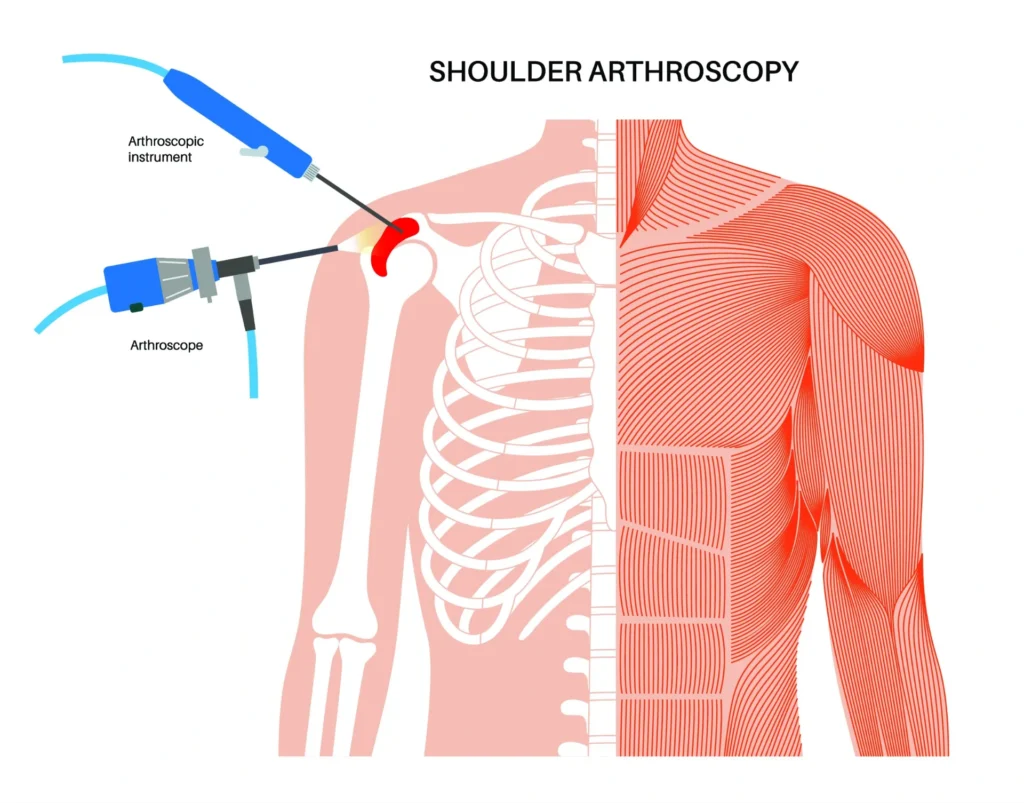
The shoulder joint is more complex than most people realize. It involves bones, cartilage, tendons, ligaments, a fluid-filled bursa, and a surrounding capsule of tissue, all working together to give you one of the most mobile joints in your body. When any of those structures are damaged, inflamed, or torn, the result can be significant pain, weakness, or instability. Arthroscopy gives us a direct window into that environment, and in most cases, the ability to treat what we find during that same procedure.
Compared to traditional open surgery, the smaller incisions may support less post-operative pain, lower infection risk, and less scarring. That said, arthroscopy isn’t the best solution for every shoulder condition. There are situations where an open approach provides a stronger, more durable repair, and when that’s the case, I will let my patient know.
What Conditions Can Shoulder Arthroscopy Treat?
This tends to surprise patients. Shoulder arthroscopy isn’t limited to one type of problem. It can address many of the most common conditions I see in practice, and the range is broader than most people expect.
Rotator Cuff Tears
The rotator cuff is a group of four muscles and tendons that wrap around the shoulder joint, keeping the ball seated in the socket and giving you the ability to lift and rotate your arm. Partial and complete tears can result from a sudden injury, repetitive overhead motion, or gradual wear over time. When surgery is necessary, I perform arthroscopic rotator cuff repair by reattaching the torn tendon to the bone through small incisions, causing less disruption to surrounding tissue than open surgery.
Labral Tears (SLAP Tears and Bankart Lesions)
The labrum is a ring of cartilage that lines and deepens the shoulder socket, contributing to stability. SLAP tears affect the top of the labrum where the biceps tendon attaches, a common injury in overhead athletes. Bankart lesions occur at the front of the socket, often after a dislocation. Both types can usually be repaired arthroscopically, restoring stability without the larger incision an open repair would require.
Shoulder Impingement Syndrome
Impingement happens when the tendons of the rotator cuff get pinched beneath the bones at the top of the shoulder during overhead movement. Many patients improve with physical therapy and targeted treatment. But when conservative care hasn’t resolved the problem, arthroscopy can create more space in the joint by removing inflamed tissue or trimming a small amount of bone.
Frozen Shoulder (Adhesive Capsulitis)
Frozen shoulder is a condition where the joint capsule becomes thickened, inflamed, and contracted, severely limiting range of motion and causing significant pain. For patients who don’t respond to physical therapy, stretching, and injections, an arthroscopic capsular release can restore movement by carefully dividing the tight, scarred tissue.
Shoulder Instability and Recurrent Dislocations
Some patients (especially younger, active individuals) experience repeated shoulder dislocations or a persistent sense that the joint shifts or feels unreliable. Arthroscopic stabilization repairs the damaged structures that normally keep the shoulder in place, reducing the risk of future instability.
Biceps Tendon Disorders, Loose Bodies, and Bone Spurs
The long head of the biceps tendon attaches inside the shoulder joint and can become inflamed, partially torn, or unstable within its groove. Depending on the issue, an arthroscopic tenodesis (reattaching the tendon in a new position) or tenotomy (releasing it from its attachment) can relieve pain effectively. Loose fragments of bone or cartilage inside the joint can also be removed arthroscopically, along with bone spurs that contribute to impingement.
What I See in My Sarasota Patients
The patients I treat here in Sarasota come from all walks of life. There are competitive athletes I consult for through IMG Academy, performing artists from the Sarasota Orchestra, active retirees who have been grinding through shoulder discomfort for months, and weekend golfers who just want to stop flinching on every backswing. What they tend to have in common is that they waited longer than they probably should have before coming in.
Pain that started as a dull ache during overhead work gradually became something that interrupted sleep. A rotator cuff tear that “didn’t seem that bad” quietly became a compensation pattern that started affecting the neck and elbow. I see this all the time, and it’s one reason I encourage patients not to wait until they’re desperate to get evaluated.
A lot of patients walk in expecting me to jump straight to surgery. In most cases, that’s not what happens. My fellowship training in Hand, Shoulder, and Arm Surgery at the University of Florida was specifically designed around the full spectrum of upper extremity conditions, and part of that training is knowing when not to operate. The most important thing I can do in that first appointment is listen carefully, look at the imaging, examine the shoulder properly, and be honest about what the anatomy is telling me.
My Approach to Treatment
My default is conservative care first: physical therapy, activity modification, anti-inflammatory options, and, where it makes clinical sense, regenerative treatments like PRP. For a meaningful number of patients, that approach gets them where they need to be.
But there are situations where the structural damage is significant enough that conservative care cannot resolve the underlying problem. A full-thickness rotator cuff tear that keeps growing isn’t going to heal on its own. A severe Bankart lesion in a 22-year-old who keeps dislocating is not a PT problem.
When surgery is the right path, shoulder arthroscopy offers real advantages for most of the conditions I treat. Smaller incisions. Less disruption to healthy tissue. In some cases, a faster early recovery. I perform these procedures at the Sarasota Memorial Hospital, HCA Florida Sarasota Doctors Hospital, Lakewood Ranch Medical Center, and the Advanced Surgery Center of Sarasota.
What to Expect Before and After Surgery
Shoulder arthroscopy is typically performed as an outpatient procedure, where patients come in and go home the same day. Before surgery, we review the specific procedure in detail, discuss anesthesia options, and set clear expectations for what recovery will look like.
Recovery depends considerably on what was done. Removing a loose body has a very different timeline than repairing a full-thickness rotator cuff tear. That said, there are some general patterns:
- After certain repairs, the arm may be placed in a sling for a period of time to protect the healing tissue. This varies by procedure and will be discussed in full before surgery.
- Physical therapy typically begins within the first few weeks, starting with gentle range-of-motion work and progressing gradually as healing allows.
- Light daily activities can often resume relatively soon after simpler procedures. More extensive repairs require a longer, more protected timeline.
- Return to sports, overhead work, or heavy physical activity takes longer and varies considerably.
Every patient I operate on gets a clear and honest recovery conversation before surgery. Not a best-case-scenario estimate, but a realistic one they can actually plan around.
Summary: Ready to Find Out If Arthroscopy Is Right For You?
Shoulder arthroscopy has helped many of my patients get back to the things that matter, including sleeping through the night, swinging a golf club without bracing for pain, and reaching overhead without hesitation.
If you’ve been dealing with shoulder pain, instability, or weakness and you’re not sure what’s causing it, or if you’ve already been told you may need surgery and want a second opinion from a fellowship-trained specialist, my recommendation is simple: come in for a consultation. Not to get you in the operating room. To figure out what’s actually going on in your shoulder and build an honest plan from there.
You can request an appointment online or call my Sarasota office directly at (941) 378-5100. My team will get you in to talk through what you’re experiencing and what your options look like.
Frequently Asked Questions
Is shoulder arthroscopy considered major surgery?
Shoulder arthroscopy is a surgical procedure, but it’s minimally invasive, meaning the incisions are small and disruption to surrounding tissue is limited. Most patients are treated as outpatients and go home the same day.
How do I know if I’m a candidate for shoulder arthroscopy?
Candidacy depends on your specific diagnosis, the state of the shoulder structures, your activity goals, and whether conservative treatment has already been attempted. A thorough evaluation helps clarify what’s actually going on and whether arthroscopy is the right match. I evaluate each patient individually and don’t apply a one-size-fits-all approach.
Can shoulder problems be treated without arthroscopy?
Absolutely. Many shoulder conditions respond well to physical therapy, activity modification, injections, or regenerative treatments like PRP. I always explore those options first. Surgery becomes part of the conversation when conservative care isn’t sufficient or when the anatomy clearly requires repair to restore function.