

The shoulder is one of the most mobile joints in the human body. It allows you to lift, throw, reach overhead, and rotate your arm in almost every direction. That mobility makes daily life possible, and it also makes the shoulder vulnerable to injury. In my practice, I evaluate and treat a wide range of common shoulder injuries. Some develop gradually from overuse. Others occur suddenly after trauma.
In this post, we’ll explore some of the most frequent shoulder conditions, what symptoms they may cause, and how treatment may be approached.
Key Takeaways
- Shoulder injuries may present with overlapping symptoms, so an accurate diagnosis is important to guide appropriate and effective treatment.
- Many shoulder conditions improve with structured physical therapy and activity modification.
- Surgical treatment may be recommended when conservative care does not provide adequate improvement.
How the Shoulder Functions
To understand common shoulder injuries, it helps to understand how the joint works. The shoulder is a ball-and-socket joint. The head of the humerus sits in a shallow socket in the scapula. Unlike the hip, which has a deep and stable socket, the shoulder sacrifices stability for mobility. That design allows an impressive range of motion. It also means the shoulder depends heavily on soft tissues for support.
The rotator cuff consists of four muscles and their tendons. These structures stabilize the joint and guide movement. The labrum, a ring of cartilage around the socket, helps deepen the joint and improve stability. Ligaments further reinforce the capsule.
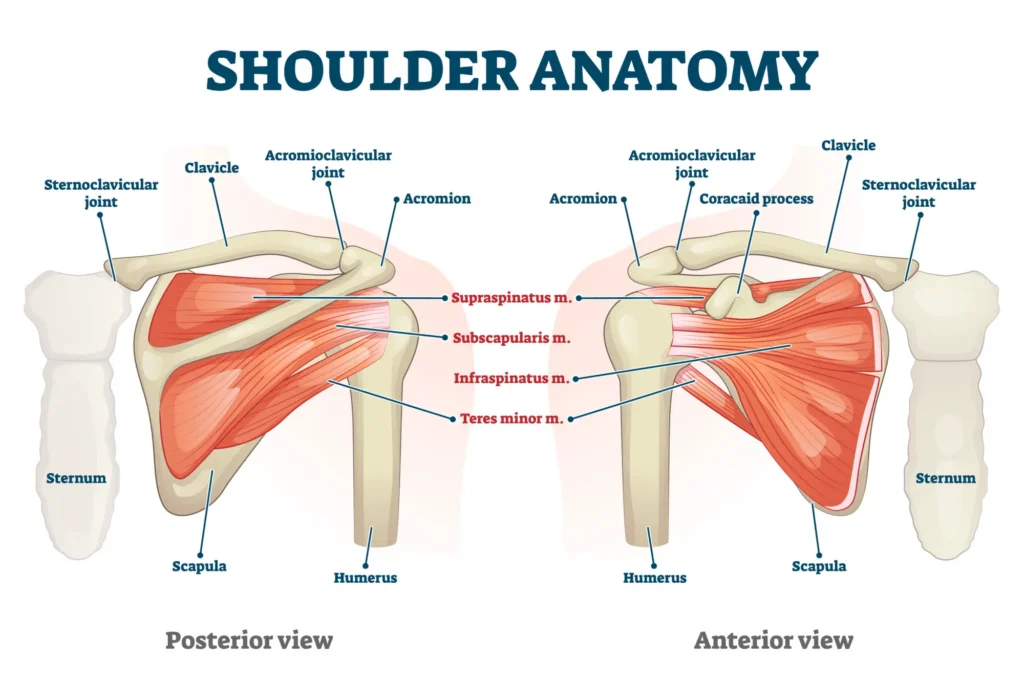
Because of this anatomy, many common shoulder injuries involve tendons and cartilage. When those tissues become inflamed, weakened, torn, or overstressed, pain and dysfunction often follow.
Rotator Cuff Tendinopathy and Tears
Rotator cuff pathology is one of the most common shoulder injuries. Tendinopathy refers to irritation or degeneration of the rotator cuff tendons. This condition may develop gradually due to repetitive overhead activity, occupational strain, or age-related changes in tendon quality. Over time, tendon degeneration can increase the risk of a partial or complete tear, although not all cases of tendinopathy progress to tearing.
A rotator cuff tear can occur after a fall or heavy lift. It can also progress slowly without a single traumatic event.
Patients often describe:
- Pain when lifting the arm overhead
- Difficulty reaching behind the back
- Weakness with lifting or rotating
- Night pain, particularly when lying on the affected side
Treatment for rotator cuff injuries usually begins conservatively. Physical therapy may be recommended to strengthen surrounding muscles and restore proper mechanics. Anti-inflammatory strategies, including medications and icing, may reduce irritation. In some cases, corticosteroid injections or platelet-rich plasma therapy may be considered.
If symptoms persist despite appropriate therapy, or if the tear significantly limits strength and function, surgical repair may be considered. Many rotator cuff repairs can be performed arthroscopically through small incisions.
Shoulder Impingement
Shoulder impingement occurs when the rotator cuff tendons or bursa become compressed during arm elevation. This condition frequently overlaps with rotator cuff irritation. Patients commonly report pain when raising the arm or reaching behind the back. Activities such as swimming, tennis, or overhead lifting may aggravate symptoms.
Impingement often responds well to non-surgical management. Physical therapy typically plays a central role, with a focus on improving posture, strengthening scapular stabilizers, and restoring coordinated shoulder motion. Addressing these factors may relieve compression and reduce inflammation. Surgery is usually reserved for persistent cases that do not respond to rehabilitation.
Shoulder Bursitis
The shoulder contains small fluid-filled sacs called bursae. These structures reduce friction between tissues. When inflamed, bursitis can cause pain and swelling. Subacromial bursitis may accompany rotator cuff irritation. Patients may feel tenderness along the outer shoulder and pain with overhead movement. In many cases, bursitis improves with rest, activity modification, and therapy. Addressing the underlying mechanical contributors remains important.
Shoulder Instability and Dislocation
Shoulder instability occurs when the shoulder moves excessively or slips out of position. A full dislocation happens when the humeral head comes completely out of the socket. Trauma, such as a fall or collision, frequently causes this injury. Younger athletes may be particularly susceptible to recurrent instability after an initial dislocation. Some individuals may experience subluxation, where the joint partially shifts but reduces on its own.
Symptoms may include:
- Sudden pain after injury
- A visible deformity in an acute dislocation
- Repeated sensations of looseness
- Apprehension in certain arm positions
When instability recurs, the labrum or ligaments may be injured. Imaging can help evaluate these structures. Treatment depends on age, activity level, and frequency of episodes. Some patients respond well to strengthening programs focused on dynamic stabilization. Others may require surgical repair to restore stability and reduce the likelihood of recurrence.
Labral Tears
The labrum deepens the shoulder socket and contributes to joint stability. Labral tears represent another category of common shoulder injuries. Trauma, repetitive overhead throwing, or instability episodes can damage this cartilage ring. A specific type known as a SLAP tear affects the upper portion of the labrum.
Patients may report deep shoulder pain, catching sensations, or reduced performance during throwing. Some describe vague discomfort that does not respond to rest alone. Treatment typically begins with physical therapy and other non-surgical treatments. When symptoms persist and significantly affect function, arthroscopic repair may be recommended.
Shoulder Fractures
Although many common shoulder injuries involve soft tissue, fractures can occur after falls or high-impact trauma. Clavicle fractures and proximal humerus fractures are common. Scapular fractures are less frequent but possible in high-energy injuries. Symptoms usually include immediate pain, swelling, and limited movement.
Some fractures heal well with immobilization and guided therapy. Others require surgical fixation to restore alignment and optimize function. Treatment decisions depend on fracture type, displacement, and patient needs.
Adhesive Capsulitis
Adhesive capsulitis, also called frozen shoulder, involves progressive stiffness and pain. The joint capsule thickens and tightens, limiting motion. This condition may develop after injury or surgery. In other cases, it appears without a clear trigger. Patients with diabetes may have a higher risk of developing frozen shoulder compared to the general population.
Frozen shoulder typically progresses through phases. Pain may dominate early, with stiffness becoming more pronounced over time. Treatment emphasizes gentle range of motion exercises and physical therapy. Injections may reduce inflammation in certain phases. While the condition tends to improve gradually, recovery can take time and patience.
Arthritis of the Shoulder
Degenerative changes in the shoulder joint can lead to cartilage loss and arthritis. Patients may experience deep aching pain, stiffness, and decreased motion. When non-surgical treatment does not provide sufficient relief, total shoulder replacement surgery may be considered. In certain cases, reverse shoulder replacement may be recommended, particularly when advanced arthritis is combined with significant or irreparable rotator cuff deficiency.
Risk Factors for Common Shoulder Injuries
Several factors may increase the likelihood of developing common shoulder injuries:
- Repetitive overhead sports or occupational activity
- Sudden increases in training intensity
- Poor biomechanics or muscle imbalance
- Prior shoulder injury
- Age-related tendon degeneration
- Trauma, such as falls or collisions
Diagnosis for Shoulder Conditions
An accurate diagnosis begins with listening. An experienced shoulder specialist may ask detailed questions about symptom onset, aggravating activities, and prior injuries. During the physical examination, range of motion, strength, stability, and tenderness may be assessed.
Depending on initial findings, imaging tests may be ordered. X-rays are often used to evaluate bone structure and alignment. Magnetic resonance imaging (MRI) can provide detailed images of soft tissues, including tendons and cartilage. Ultrasound imaging may also be used in certain cases. It can provide real-time visualization of tendons and soft tissues, help identify rotator cuff tears or inflammation, and may assist in guiding injections when appropriate.
Treatment Philosophy
Conservative Treatment
Many common shoulder injuries respond to conservative care. Initial management may include the following strategies:
- Activity modification
- Structured physical therapy
- Anti-inflammatory or pain medications
- Corticosteroid injections when appropriate
- Platelet-rich plasma therapy
Surgical Treatment
When conservative treatment fails to provide sufficient improvement, surgery may be appropriate. Arthroscopy is a minimally invasive technique, performed through small incisions, that may be used to address rotator cuff tears, labral injuries, and instability. In cases of advanced arthritis or complex structural damage, shoulder replacement surgery may be considered as a treatment option to improve pain and function, depending on the individual patient’s condition and goals.
Prevention Strategies
Although not all shoulder injuries are preventable, certain measures may help reduce your risk:
- Warm up before sports or exercise
- Maintain balanced shoulder strength
- Gradually increase training intensity
- Use proper technique
- Avoid repetitive strain without adequate recovery
Summary
Common shoulder injuries affect individuals of all ages and activity levels. Conditions such as rotator cuff tears, impingement, bursitis, instability, labral tears, arthritis, and fractures can interfere with shoulder function and quality of life. Many patients improve with conservative treatment that includes structured rehabilitation and thoughtful activity modification. Others may benefit from surgical intervention when structural damage limits recovery. If you are experiencing persistent shoulder pain or instability, a thorough evaluation can clarify the diagnosis and guide appropriate next steps.
Frequently Asked Questions
What are the most common causes of shoulder pain?
Rotator cuff pathology, impingement, bursitis, instability, and arthritis frequently contribute to shoulder discomfort.
Can rotator cuff tears heal without surgery?
Some partial tears and degenerative conditions respond well to physical therapy and other non-surgical treatments. Complete tears that cause significant weakness or functional limitation may be evaluated for surgical repair, depending on factors such as age, activity level, symptom severity, and overall health.
How long does recovery from shoulder surgery take?
Recovery timelines can significantly vary depending on the condition, procedure, and individual health factors. Many patients participate in physical therapy for several months following a surgical procedure to help restore strength and motion.