


Medically reviewed by Christopher L. Dillingham, M.D. | Reviewed June 2026
Shoulder impingement is one of the most common reasons patients come into my Sarasota office, and it usually shows up the same way: pain when reaching overhead, pain when reaching behind the back, and a nagging ache that gets worse with certain activities and better with rest. If that sounds familiar, you may be dealing with shoulder impingement, and I want to explain what is actually happening inside the joint, why it develops, and what treatment usually looks like.
Key Takeaways
- Shoulder impingement happens when rotator cuff tendons become compressed in the narrow space beneath the shoulder blade, most often with overhead movement.
- Left untreated, the compression can lead to ongoing inflammation or, over time, contribute to tearing.
- Arthroscopic surgery may be considered when symptoms persist despite a real course of conservative care.
What Is Shoulder Impingement?
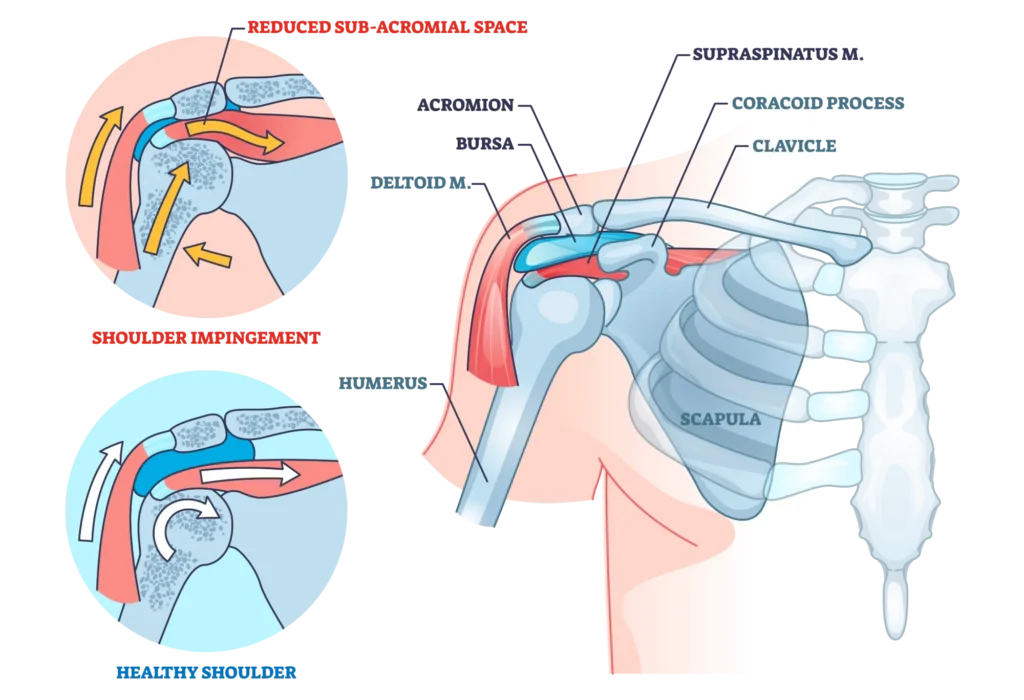
The shoulder relies on a narrow space beneath a bony arch called the acromion, where the rotator cuff tendons pass through on their way to attach to the arm bone. Shoulder impingement occurs when those tendons become compressed as they move through that space, particularly during overhead motion. The compression irritates the tendons and the small fluid-filled sac, called the bursa, that normally helps everything glide smoothly.
This is a mechanical problem as much as it is an inflammatory one. Something is narrowing that space or changing the way the tendons travel through it, and the irritation that follows is the body’s response to that repeated friction.
What Causes Shoulder Impingement?
Impingement frequently develops from repetitive overhead activity. Swimming, tennis, painting, and certain occupational tasks all place the shoulder in positions that compress the space beneath the acromion over and over. Poor posture plays a role too. When the shoulder blade sits in a forward, rounded position, the space available for the rotator cuff tendons shrinks, which can make impingement more likely even without an obvious new activity.
In some patients, the shape of the acromion itself contributes. A few people are simply built with a narrower subacromial space, which predisposes them to symptoms even with relatively normal activity levels. Bone spurs that develop over time can have a similar effect, gradually narrowing the space further.
Who Tends to Develop Shoulder Impingement?
A few patterns show up consistently in the patients I see:
- Swimmers, tennis players, and golfers, whose sports require repeated overhead motion
- Workers in jobs that involve frequent overhead reaching, like contractors, electricians, and hairstylists
- Patients with rounded, forward shoulder posture, often from long hours at a desk
- Older adults, since the subacromial space can narrow gradually with age-related changes
None of these guarantee impingement will develop, and plenty of patients have no clear risk factor at all.
Symptoms of Shoulder Impingement
Most patients describe pain with overhead reaching, whether that means putting away dishes, swimming, or serving a tennis ball. Reaching behind the back, such as zipping up clothing, can also provoke discomfort. Pain at night, especially when lying on the affected side, is common as well. Weakness sometimes accompanies the pain, particularly if the irritation has been present long enough to affect how the rotator cuff functions day to day.
Because impingement and rotator cuff tendinopathy commonly overlap, the symptoms alone do not always tell the full story. I rely on a combination of history, physical exam, and sometimes imaging to understand exactly what is contributing to a patient’s pain.
How I Diagnose Shoulder Impingement
During the exam, I move the shoulder through specific positions that tend to reproduce impingement symptoms when the diagnosis is correct. I am also checking strength, since significant weakness can point toward a coexisting rotator cuff tear rather than impingement alone.
Imaging is not always required, but X-rays can help evaluate the shape of the acromion and identify bone spurs. An MRI may be ordered if symptoms persist despite therapy or if I want a clearer picture of the rotator cuff tendons before deciding on next steps.
I also pay close attention to how a patient holds and moves their shoulder blade throughout the exam, not just the shoulder joint itself. Impingement is rarely an isolated problem confined to one structure. The shoulder blade, the upper back, and even posture at the desk or behind the wheel all influence how much room the rotator cuff tendons have to move freely.
What I See in My Patients
A large share of my impingement patients in Sarasota are swimmers, tennis players, and golfers, people whose sport puts the shoulder in that overhead position again and again. I also see it often in patients whose jobs involve reaching overhead all day, from contractors to hairstylists. The pattern is usually the same: someone manages the ache for months, modifies how they sleep, and only comes in once it starts limiting things they care about, like their tennis game or their ability to work a full shift without pain.
One thing I have learned treating this condition for years is that posture and shoulder blade mechanics matter. I have had patients with relatively mild overhead demands develop significant impingement simply because of how their shoulder blade sits and moves, and addressing that mechanical piece often makes a bigger difference than I expected early in my career.
My Approach to Treatment
I start almost every impingement case with physical therapy, and I mean that as more than a formality. A good therapy program focused on posture, scapular stabilization, and restoring coordinated shoulder motion can resolve a meaningful percentage of impingement cases without ever needing an injection or a procedure. I tell patients that the exercises that feel the least dramatic, the small scapular strengthening movements, may be doing the most work.
Anti-inflammatory medication or a corticosteroid injection may have a role for patients whose pain is limiting their ability to participate in therapy. I use these selectively rather than as a default, since I would rather a patient build strength than rely on an injection that only addresses the symptom temporarily. For some patients, especially those with overlapping tendon irritation, regenerative treatments such as PRP may also be appropriate as part of a broader conservative plan.
Surgery is reserved for the patients who have given therapy a genuine effort, typically several months, and still have symptoms that limit their function. In those cases, I may recommend arthroscopic surgery to create more room in the subacromial space, often combined with treatment of any rotator cuff irritation found during the procedure. This is performed through small incisions, which generally means less tissue disruption and a more comfortable early recovery compared with an open approach.
When to Be Concerned About Tearing
One reason I do not recommend ignoring shoulder impingement is the relationship between ongoing compression and tendon health. Tendons that are chronically irritated do not function as well as healthy tendons, and over time, that irritation can contribute to a partial or even complete rotator cuff tear. I am not saying every case of impingement leads to a tear, because most do not, but the relationship is there.
I have seen this play out often enough in my own patients that it shapes how I counsel people early in their care. A patient who treats the first month of symptoms seriously, with physical therapy and activity changes, tends to have a much shorter overall course than one who pushes through the pain for a year before getting evaluated.
Summary
Shoulder impingement is common, mechanical, and usually very treatable, especially when addressed before the irritation has had months or years to build. Physical therapy focused on posture and shoulder blade mechanics resolves a large share of cases, and surgery remains available for the smaller group who need it. If overhead reaching or sleeping on your shoulder has been painful for more than a few weeks, schedule an evaluation so we can confirm the diagnosis and start a treatment plan that fits your activity level and your goals.
Frequently Asked Questions
Is shoulder impingement the same as a rotator cuff tear?
Not necessarily. Impingement involves compression and irritation of the tendons, while a tear involves an actual disruption of the tendon tissue. The two conditions can overlap, which is part of why a thorough exam matters.
What activities should I avoid if I have shoulder impingement?
Overhead activities that reproduce your pain, such as certain swimming strokes or repetitive reaching, are worth modifying temporarily while you work through therapy. I can help you identify specific activities to adjust based on your exam.
When is surgery necessary for shoulder impingement?
Surgery is generally reserved for patients whose symptoms persist despite a genuine course of physical therapy and other conservative measures, or for those with structural issues, like bone spurs, that are unlikely to improve without intervention.