


Medically reviewed by Christopher L. Dillingham, M.D. | Reviewed June 2026
Most of my patients describe the same pattern: a dull ache that builds over a few weeks, then one morning the arm simply will not reach the cabinet shelf anymore. If your shoulder has been getting stiffer instead of better, you may be dealing with a frozen shoulder. I see this condition regularly in my Sarasota practice, and in this post, I want to walk you through what a frozen shoulder is, why it develops, and how I approach treatment.
Key Takeaways
- A frozen shoulder, also called adhesive capsulitis, develops when the shoulder capsule thickens and tightens, which can severely limit motion in nearly every direction.
- Symptoms tend to move through phases, and pain and stiffness do not always peak at the same time.
- Conservative care, including physical therapy and certain injections, is usually where treatment starts.
- Arthroscopic treatment may be considered for patients whose symptoms do not improve with time and therapy.
What Is Frozen Shoulder, Exactly?
The shoulder is a ball-and-socket joint, and that joint sits inside a capsule of connective tissue that normally stays loose enough to allow a wide range of motion. With a frozen shoulder, that capsule thickens and tightens around the joint. The result is stiffness that tends to show up in nearly every direction of movement, not just one.
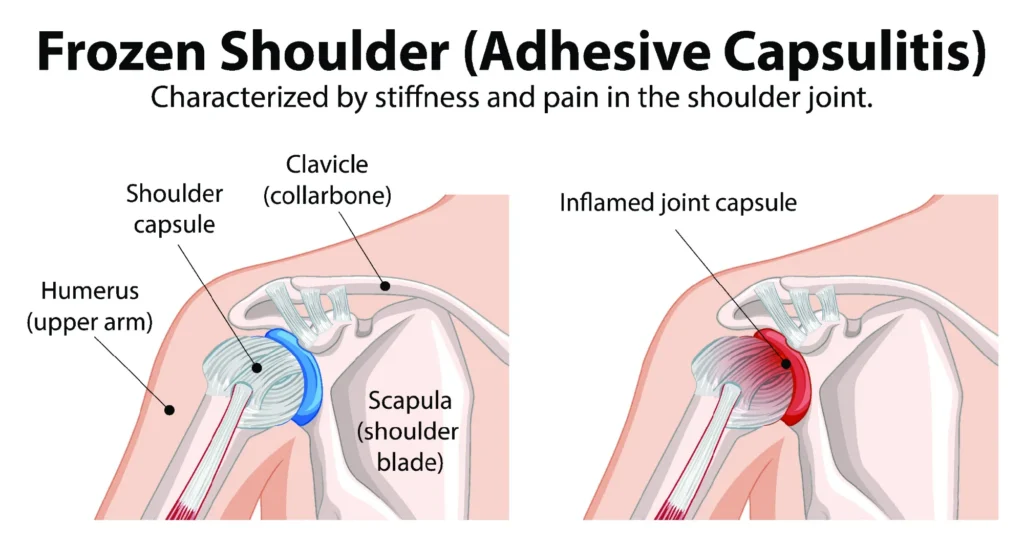
This is part of what makes a frozen shoulder different from a lot of other shoulder problems I treat. A rotator cuff tear, for example, often limits specific motions like reaching overhead or behind the back, while strength and other movements may stay relatively normal. A true frozen shoulder restricts motion broadly. Patients cannot lift the arm, rotate it outward, or reach across the body without significant resistance, and the restriction shows up whether they are trying to move the arm themselves or someone else is gently moving it for them.
What Causes a Frozen Shoulder?
A frozen shoulder can develop after an injury or a prior shoulder surgery, particularly when the joint has been kept still for an extended period. In many cases, though, there is no clear trigger at all. Patients tell me they cannot point to a single event that started it.
One risk factor stands out clearly in the patients I treat: diabetes. Individuals with diabetes appear to have a higher likelihood of developing a frozen shoulder compared with the general population. I always ask new patients about their medical history for this reason.
Symptoms and How They Progress
A frozen shoulder typically moves through phases rather than appearing as one static problem. Pain tends to dominate the early phase, often worsening at night and interfering with sleep. This is called the “freezing” stage. As the condition progresses into the “frozen” stage, the pain may gradually settle while stiffness becomes the more pronounced issue. Many patients describe this as confusing, since the shoulder can feel like it is getting “better” on the pain side while actually getting more limited in motion.
Eventually, most patients begin to regain motion in the “thawing” stage, though this final phase can take a lot of patience.
It helps to think of the condition less as a single event and more as a process the shoulder works through. Some patients move through the phases in a matter of months. Others take considerably longer, particularly if the early pain phase was severe or if treatment did not start until stiffness had already become severe.
How a Frozen Shoulder Differs From Other Causes of Stiffness
Shoulder stiffness is not unique to adhesive capsulitis. Arthritis can produce stiffness alongside more localized pain and is often associated with grinding or catching sensations during movement. A rotator cuff tear can also limit how far the arm moves, but typically alongside noticeable weakness rather than the broad, resistant stiffness seen with a frozen shoulder. Even prolonged immobilization after a fracture or other injury can leave a shoulder feeling tight.
Because these conditions can overlap, I do not rely on a patient’s description alone. The exam, and sometimes imaging, helps separate a true frozen shoulder from these other possibilities, since the treatment approach for each is different.
What I See in My Patients
Sarasota has an active, outdoor population. A lot of my patients golf year-round, play pickleball several mornings a week, or swim laps at their community pool, and a frozen shoulder tends to interrupt all of it at once. I have had patients come in convinced they tore something during a golf swing, only for the exam to show the broad, multidirectional stiffness that points to adhesive capsulitis instead of a tear.
What strikes me most is how long people wait. They assume the ache will pass on its own, and by the time they come in, the stiffness has already set in. I would rather see someone early, even if it turns out to be a mild case that responds quickly to therapy, than see them months into a frozen phase that has become harder to move through.
How I Diagnose a Frozen Shoulder
Diagnosis starts with a conversation about how the stiffness began and how it has changed over time, followed by a physical exam. I compare active motion, what you can do on your own, with passive motion, what I can move your arm through while you relax. When both are similarly restricted, that pattern points strongly toward a frozen shoulder rather than a rotator cuff problem.
Imaging is not always necessary to make the diagnosis, but I may order an X-ray to rule out arthritis or other bony causes of stiffness. An MRI is occasionally used when the picture is not entirely clear or when I want to rule out a coexisting rotator cuff tear.
My Approach to Treatment
In my practice, treatment almost always starts with a structured course of physical therapy focused on gentle range-of-motion exercises. Pushing too hard, too early can aggravate the capsule, so I work with therapists who understand the difference between productive stretching and overdoing it.
Depending on which phase a patient is in, I may also recommend a corticosteroid injection to help calm inflammation and make therapy more tolerable. I find these injections tend to be most useful earlier in the process, when pain is the dominant complaint, rather than later when stiffness has taken over.
For most patients, this conservative path is enough. The timeline varies quite a bit from person to person, and I would rather set realistic expectations upfront than promise a quick fix that does not hold up. A frozen shoulder that has been building for months is not going to resolve in a couple of weeks of stretching, and I tell my patients that directly.
When Surgery May Be the Right Step
For a smaller group of patients, symptoms do not improve despite consistent therapy and appropriate injections. In those cases, I may recommend arthroscopic treatment to release the tightened capsule tissue. This is performed through small incisions using a camera and specialized instruments, which generally allows for less tissue disruption than an open approach.
Summary
A frozen shoulder can be frustrating precisely because it tends to move slowly, through phases that do not always feel like progress in the moment. Most cases improve with a combination of targeted physical therapy, patience, and, when appropriate, an injection to ease the way. If your shoulder has been getting stiffer instead of better for more than a few weeks, do not wait for it to resolve on its own before getting evaluated. Schedule a visit so we can determine which phase you are in and build a treatment plan around it.
Frequently Asked Questions
Will a frozen shoulder go away without treatment?
Some cases may improve gradually on their own, but the process can take a long time and the stiffness phase tends to respond better when guided by structured physical therapy rather than left alone.
Is a frozen shoulder the same thing as a rotator cuff tear?
No. A rotator cuff tear typically limits specific motions and is often associated with weakness, while a frozen shoulder usually restricts motion broadly in nearly every direction, with both active and passive movement affected.
Does having diabetes increase the risk of a frozen shoulder?
Patients with diabetes may have a higher likelihood of developing a frozen shoulder compared with the general population, which is part of why I ask every new patient about their medical history.
When should I consider scheduling an appointment?
If stiffness has been building and is not improving, or if it is starting to interfere with sleep or daily activities, an evaluation can help confirm the diagnosis early and start you on the right treatment path.